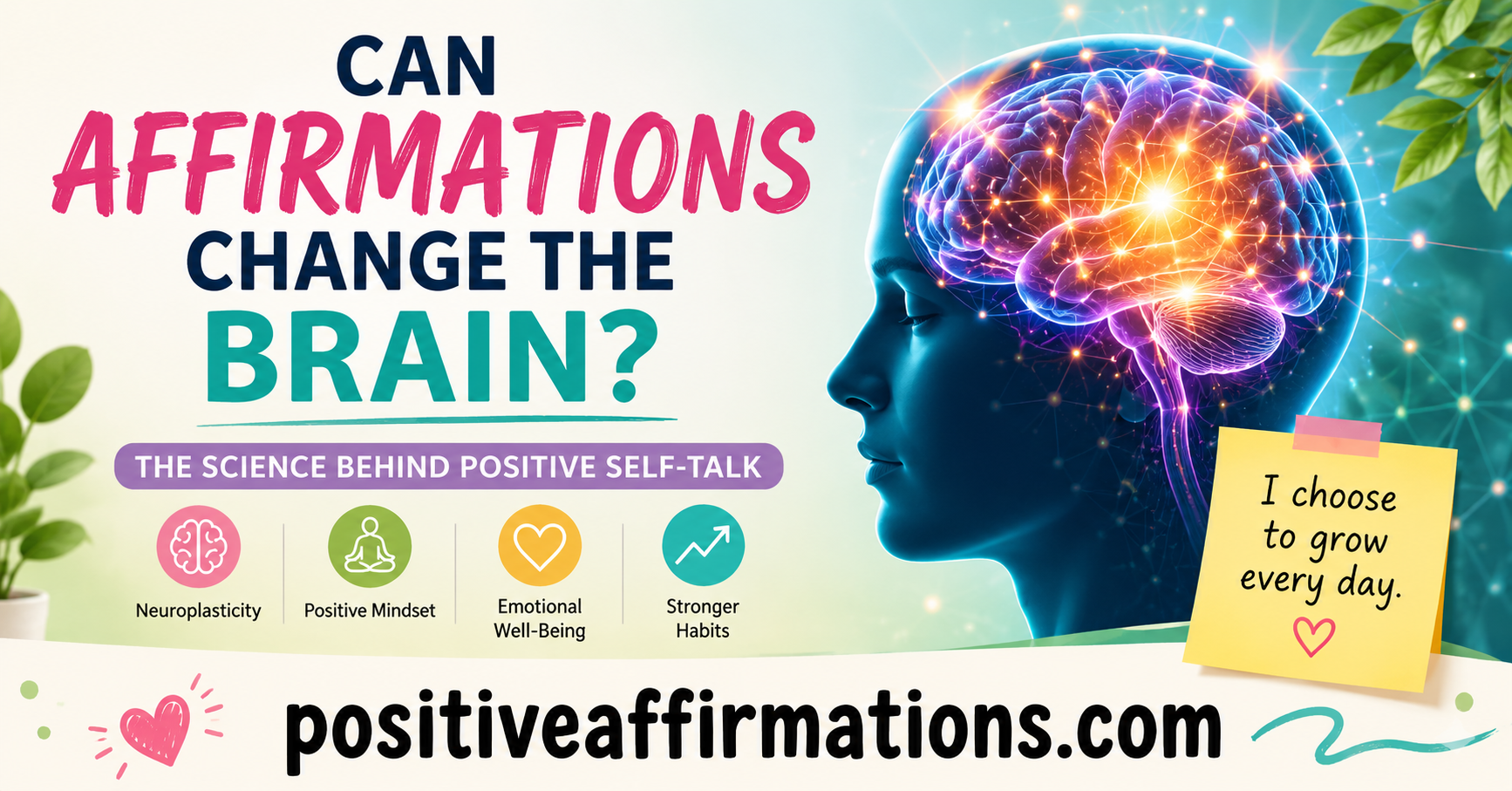
For years, affirmations were often dismissed as “feel-good quotes” or wishful thinking. But modern psychology and neuroscience suggest there may be more happening beneath the surface.
Can repeating positive statements actually change the brain?
Surprisingly, research suggests the answer may be yes — at least to a degree.
Affirmations are not magic, and they do not instantly erase trauma, anxiety, or depression. But studies in psychology and brain imaging show that repeated positive self-talk may influence neural pathways, stress responses, emotional regulation, and behavior over time.
Here’s what the science actually says.
What Are Affirmations?
Affirmations are intentional statements designed to reinforce positive beliefs, values, or behaviors.
Examples include:
- “I am learning to trust myself.”
- “I can handle difficult situations.”
- “I deserve respect and kindness.”
- “I am becoming more confident every day.”
The idea behind affirmations is simple: repeated thoughts influence mental patterns. Over time, those patterns may shape emotions, habits, and behavior.
This concept connects closely to something called neuroplasticity.
What Is Neuroplasticity?
Neuroplasticity refers to the brain’s ability to adapt, reorganize, and form new neural connections throughout life.
In simple terms:
The brain changes based on repeated experiences, behaviors, thoughts, and emotions.
For decades, scientists believed the adult brain was mostly fixed. Modern neuroscience has shown that the brain is far more adaptable than previously thought.
Repeated mental activity strengthens certain neural pathways while weakening others.
This is why:
- habits become automatic,
- fears can become conditioned,
- and repeated negative thinking can reinforce anxiety or low self-esteem.
The same principle may help explain why affirmations can influence thought patterns over time.
The Brain That Changes Itself discusses many examples of the brain adapting and reorganizing itself through repeated mental and behavioral experiences.
What Happens in the Brain During Affirmations?
Researchers studying self-affirmation have identified changes in brain activity associated with self-processing and reward systems.
One widely cited brain imaging study published in Social Cognitive and Affective Neuroscience found that self-affirmation activates regions associated with:
- self-related processing,
- valuation,
- reward,
- and future-oriented thinking.
In particular, researchers observed activity in the:
- ventromedial prefrontal cortex (vmPFC)
This area of the brain is involved in:
- self-perception,
- emotional regulation,
- decision-making,
- and assigning value to experiences.
The study also suggested that self-affirmation may help make people more receptive to positive behavior change.
How Repetition May Influence Neural Pathways
The brain becomes more efficient at whatever it repeatedly practices.
This applies to:
- playing an instrument,
- learning a language,
- worrying constantly,
- or practicing healthier self-talk.
Repeated negative thoughts can strengthen pathways connected to fear, shame, self-criticism, and stress.
Affirmations may help interrupt and gradually reshape some of those automatic patterns through repetition and emotional reinforcement.
Some psychologists compare this process to creating a new mental “path” that becomes easier to access over time.
This does not happen instantly.
Just as physical exercise gradually strengthens muscles, repeated thought patterns may gradually strengthen neural connections associated with confidence, resilience, and self-worth.
Research on Stress and Self-Affirmation
Some studies suggest affirmations may help reduce stress responses.
Research connected to self-affirmation theory has found that affirming personal values may:
- reduce defensiveness,
- improve emotional resilience,
- increase openness to feedback,
- and improve responses to stressful situations.
In one study, participants who practiced self-affirmation showed different brain responses when receiving health-related information, making them more open to behavior change.
Other research has linked self-affirmation practices with:
- improved academic performance,
- lower stress,
- and improved coping during pressure-filled situations.
Can Affirmations Help Anxiety?
Possibly — especially when used realistically.
Some therapists and psychologists believe affirmations may help reduce anxious thinking patterns by redirecting attention away from catastrophic self-talk.
For example:
Instead of:
“I can’t handle this.”
A person may gradually reinforce:
“I can handle discomfort one step at a time.”
This kind of cognitive reframing may help calm excessive threat-focused thinking.
However, experts also caution that affirmations work best when they feel believable and emotionally grounded.
Unrealistic affirmations can sometimes create internal resistance.
For example:
- Someone with severe anxiety may not emotionally connect with:
“I am completely fearless.”
But they may respond better to:
- “I am learning to feel safer and more confident.”
Research suggests affirmations are more effective when they align with a person’s actual values and emotional state.
The Brain Does Not Change Overnight
One important misconception is that affirmations create instant transformation.
They do not.
The brain changes through repetition, consistency, emotion, and experience.
A few days of repeating positive phrases is unlikely to completely override years of negative conditioning.
That’s why affirmations are generally most effective when combined with:
- healthy habits,
- therapy,
- mindfulness,
- emotional processing,
- goal-setting,
- and supportive environments.
Affirmations may help reinforce change — but they are rarely enough by themselves.
What Science Does NOT Say
There is growing evidence that affirmations can influence mindset and stress responses, but scientific research does not support exaggerated claims such as:
- “Affirmations can cure all mental illness.”
- “You can manifest anything instantly.”
- “Positive thoughts alone completely rewire your life.”
The science is more balanced than that.
Affirmations may help support:
- emotional resilience,
- self-confidence,
- behavior change,
- and healthier mental patterns.
But they are not substitutes for:
- therapy,
- medical treatment,
- trauma work,
- or professional mental health care.
How to Use Affirmations More Effectively
Research and clinical experience suggest affirmations work best when they are:
Realistic
Choose affirmations your mind can gradually accept.
Emotionally Relevant
Generic statements are often less effective than meaningful personal ones.
Repeated Consistently
Neural pathways strengthen through repetition.
Paired With Action
Behavior reinforces belief.
Focused on Growth
Progress-based affirmations often work better than perfection-based ones.
Examples:
- “I am learning.”
- “I am growing stronger.”
- “I can improve with practice.”
Final Thoughts
Science suggests affirmations may influence the brain through neuroplasticity, self-processing systems, emotional regulation, and repeated thought reinforcement.
While affirmations are not magical cures, they may help shift attention, reduce negative self-talk, and support healthier mental habits over time.
The brain is shaped by repetition.
And the way we repeatedly speak to ourselves matters more than many people realize.
References
- Cascio, C. N. et al. (2015). Self-affirmation activates brain systems associated with self-related processing and reward. Social Cognitive and Affective Neuroscience.
- Falk, E. B. et al. (2015). Self-affirmation alters the brain’s response to health messages and subsequent behavior change. Proceedings of the National Academy of Sciences.
- Steele, C. M. (Self-Affirmation Theory research referenced in multiple psychology studies).
- The Brain That Changes Itself by Norman Doidge.
- Psychology Today – Affirmations and Neuroplasticity

Michael Z. is the founder of PositiveAffirmations.com and a strong believer in the power of mindset to shape everyday life. His interest in affirmations grew from personal experience with growth, resilience, and learning how to redirect negative inner dialogue into steady self-belief.
Through this platform, he shares structured, practical affirmation collections designed to support confidence, emotional balance, and personal progress. His goal is simple: to create a space where words are used intentionally to strengthen, not weaken, the mind.